Better Bodystorming Quick Tip: Identify Places w/Lables on Floor

October 23rd, 2010

A quick way to show actors are in different places (yet communicating with each other) is to write the place name on a sheet of paper (like you do with actor labels) and put them on the ground.  Then when someone steps on that, that signifies they are in that location. Think of this as a split screen technique from film making. The split screen ruptures the illusion that the “frame” is a seamless view of reality. We see this technique to simultaneously portray both participants in a telephone conversation.

Here are some examples.

See Also

Better Bodystorming Quick Tip: Using Actor Labels

A site dedicated to split screen techniques. I am looking to mine some of the techniques here for future bodystorms.

Bodystorming NY IxDA: A Directed Bodystorm

October 21st, 2010

Here is a short video of a bodystorming on Personal Learning Environments that we did at the NY IxDA. It was a “directed” bodystorm and you can hear me calling or directing certain roles to enter/participate at certain points.

Better Bodystorming Quick Tip: Using Actor Labels

October 19th, 2010

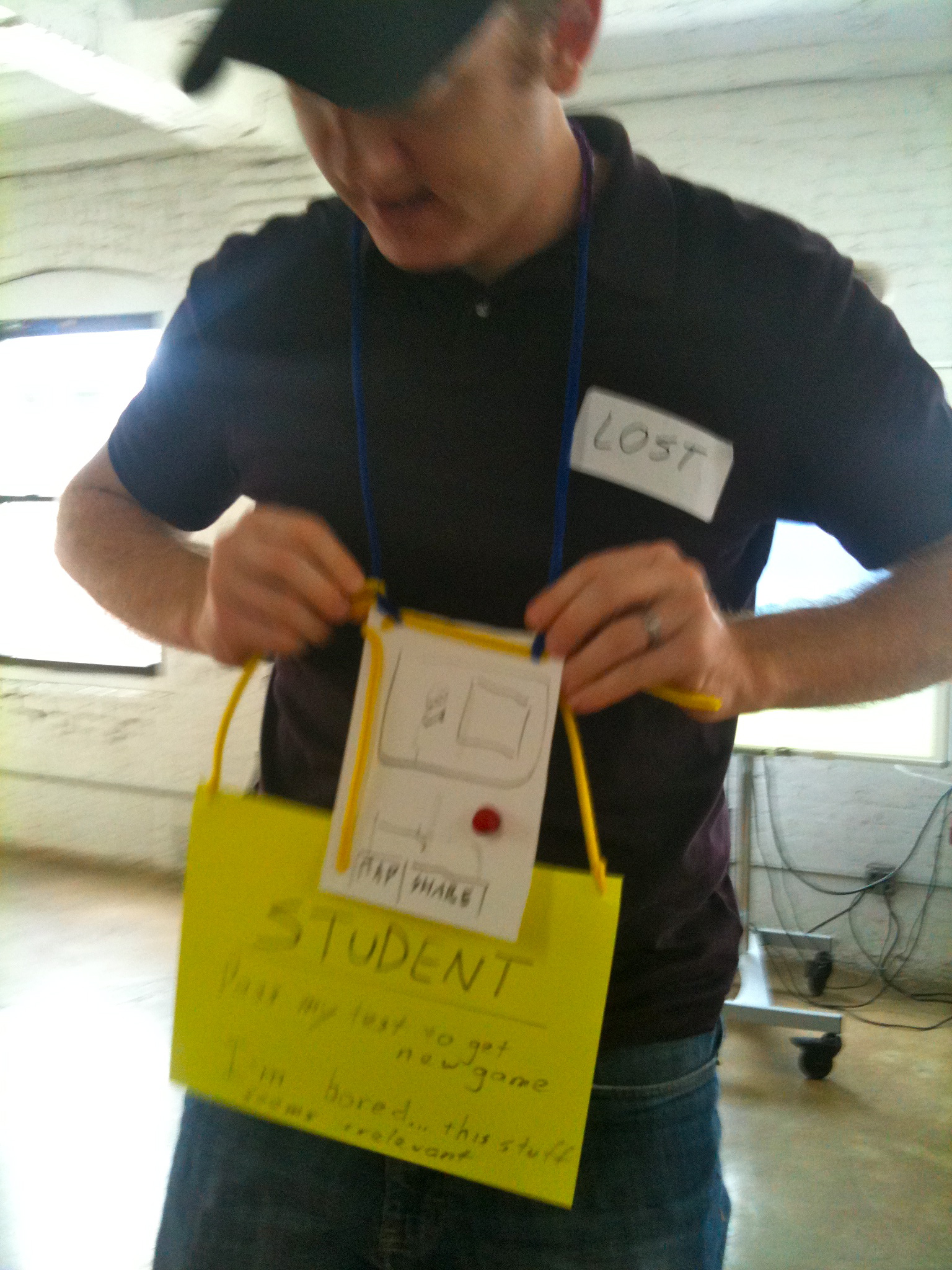
A good way to make bodystorming easier both for the participants and the viewers is to use Actor Labels.Actor Labels are BIG labels that you hang around people’s necks to make it easy for others to know what actor they are playing. That way you don’t have to spend as much time trying to figure out how to portray a young child if you don’t look like on

In the October 16th afternoon bodystorm we made Actor Labels mandatory and we had some good examples that you can see in the photos below.  We wrote the actor’s goal and feelings on the front of the card in addition to the role. The best materials seemed to be thick paper or construction paper and pipe cleaners. These are three good examples of actor labels that we used in the bodystorming.

See Also: Other Bodystorming Tips

9 Tips for Better Bodystorming

On why Actors should have Feelings in addition to Goals (Setting analysis example)

Bodystorming in NY

October 19th, 2010

This past weekend, Saturday October 16th, we did a bodystorm in Brooklyn NY. Actually two bodystorms. One in the morning and one in the afternoon. Everyone had a good time and really put their heart into it.

We worked on Personal Learning Environments of the future. I had a great time and feedback was very positive. I’ll blog separately about some of the interesting things that came out.

Bodystorming Homework for Oct 8 Bodystorm at SCAD in Savannah

October 5th, 2010

If you are participating in the Bodystorm this Friday you are in for a great time.

We will be working on storming out ideas on education.
We will be inventing the learning system (rather than the school system) of the future. Just as we are user-centered instead of product-centered, we we be learner-centered rather than school-centered.

For your homework do the following exercises.
1. Find someone you know who is a public school student. First ask them what they think is cool. What they are interested in. Then ask them what classes do they have and what did they learn today.
2. Think about what you do for work and what is the different between that and homework. (If you don’t work and are in school then do the opposite.)
3. What tools or resources help you learn best?

How to help your people get better as Experience Designers w/o managing more

October 5th, 2010

Learning More by reflecting on your work: A Structured Review Process from Education

Peter Pappas wrote about the “reflective student” subtitled: “Dedicated to relinquishing responsibility for learning to the students.” How does that relate to what we see going on in management – relinquishing responsibility for “management” to the worker/staff? Perhaps similarly as Peter Pappas has the student move to being a “reflective student” we would need to move the worker/staff to being a “reflective worker/staff.”

The 6 Reflections

  1. What did I do? Did I get it done on time?
  2. What was important about what I did?
  3. Where could I use this again? Are their ways to adapt it to other projects?
  4. Did I see any patterns in what I did?Were the strategies, skills, and procedures I used effective for this project? What were the results of the approach I used – was it efficient, or could I have eliminated or reorganized steps?
  5. How well did I do? Did I do an effective job of communicating my work to others? What have I learned about my strengths and my areas in need of improvement? How am I progressing as a designer?
  6. What should I do next? How can I best use my strengths to improve?

SEE ALSO

The Top Ten Mistakes UX (User Experience) Leaders Make

Talking About Managing

Bodystorming in Savannah

October 3rd, 2010

This Friday we will be bodystorming at the Collaborative Open Innovation Network (COINs2010) conference in Savannah.  Here is a link to the workshop information for bodystorming in Savannah.

Prototyping at the Systems Level

October 1st, 2010

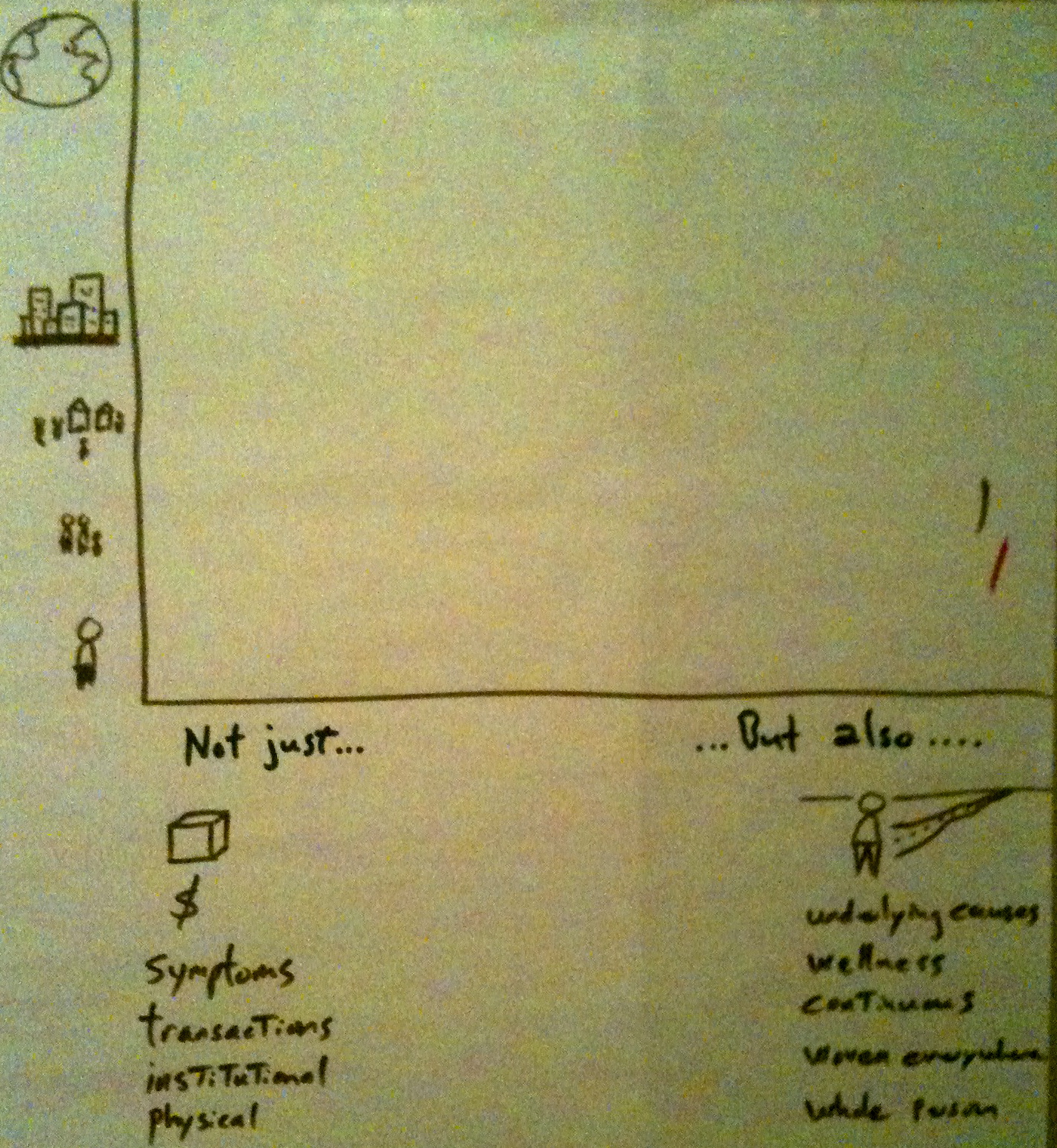
Marc Rettig presented at the local IxDA in State College. A good crowd and great discussion. He put up the diagram you see below and talked about the upper right of the chart. which gets more on the Y-axis toward the world, cities and system and on the X-axis toward underlying causes, wellness and whole person.

If design thinking is about iteration, prototyping (or as Marc put it “Understand & Try” with prototypes between) then how do we approach problems/opportunities at that systems level with this type of practice.

Can we prototype at the systems level?

Some possible approaches might be:

  • The Function- Structure- Process Model
  • Agent-based modeling that scales quickly up to the complexity of the systems level.
  • Systems-Level Experimentation (which can be used to drive disruptive innovation.)
  • Alex Osterwalder’s Business Modeling as a sort of systems level view and playing board, but I need to start to connect various business models together to really get at a systems view.

Recommended number of “Design Thinkers” for a company

September 28th, 2010

How many Design Thinkers should your company have?

One way to think about it might be . . .
If we consider Design Thinkers to be at the level of strategy. And most corporations do ok if their executives spend about 1 or 2 days a year on strategy or about 1/2 of a percent of their time. And if management to staff ratio is 1:11.

If a company has 10000 people, then about 900/100 = 9

Company size 1000 = 1 Design Thinker
Company size 10K = 9 Design Thinkers
Company size 100K = 90 Design Thinkers

*******
The above is just a thought exercise in trying to come up with a heuristic for an executive who asks “Hey, I agree that Design Thinking is important, I am going to start a department, How many Design Thinkers should I hire?” Can we even think about staffing Design Thinkers like we think about staffing accountants or salespeople?

Top 6 ways of working from “Making Ideas Happen” by Scott Belsky

September 10th, 2010

My notes from “Making Ideas Happen” by Scott Belsky
Top 6 ways of working – These are the top 6 ways of working that I think will have the most impact in moving my user experience ideas forward.

1 (p215)
The backward clock – You are sitting in a dull meeting. Tuning out the conversation, you become entranced by the passage of time on the wall clock. You watch sixty second pass, a minute of your life you will never get back.
During that time, were you taking any risks to push your ideas toward fruition? Were you moving the ball forward in any way? Were you marketing yourself for an opportunity to get closer to your true interests — or angling to further develop an area of expertise? Were you harnessing the forces of connection and opportunity around you?

2 (p98)
It should be clear by now that organizing life into a series of projects

3 (p98)
Manage those projects with a bias toward action, and always moving the ball forward are critical for execution

4 (p151)
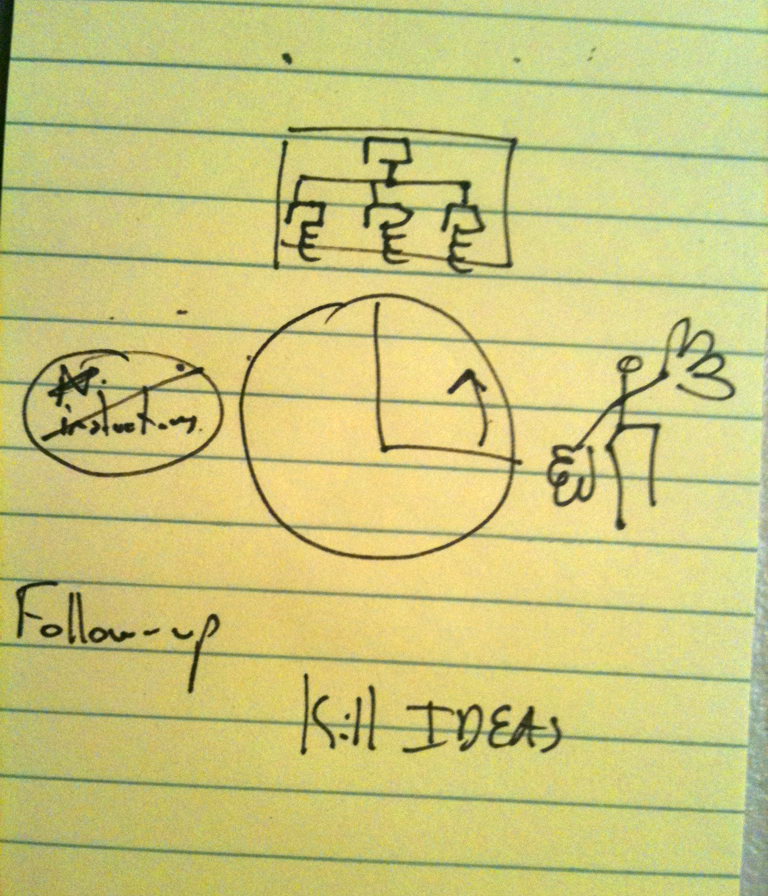
Fight the desire to wait for instructions

5 (p84)
I’m starting to believe that life is just about following up

6 (p77)
Kill ideas liberally — for the sake of fully pursuing others