Archive for the ‘Uncategorized’ Category

Forget Personas, Do Bodystorming

Thursday, September 10th, 2009

Bodystorming is the New Personas.
Why Bodystorming Works?  Need states. It focuses on need states.

Bodystorming is a kind of research (testing) that helps identify “need states.” Most of the time you sit around and talk about classifying your customers by demographics like age or gender, or psychographics like lifestyle or even behaviors like purchasing patterns. If you are lucky you bring in research or go out and do research on these different segments. Instead, or in addition to do that, bodystorming through projective role playing forces you to focus on the need states. (Need states = And for a single product there can be multiple need states. And a product can’t be all things for all needs. FOCUS.

Understand the need state and you bodystorm if it is done well will SATISFY. A good bodystorm is one that captures the need state and shows how it is satisfied.
A good bodystorm is one that in it’s immediacy and intemacy shows a customer at a level of how they are experiencing at that very moment your brand.

We need to focus more on the different usage occasions with the product and service and the needs that define them. That is exactly what bodystorming does. It goes even further because it allows both us as designers and business owners to see and understand what is working and what’s not working so that we can interpret design opportunities.

References
The needs of a segment should drive design

Some work that calls for going beyond need states to cultural occasions
What would happen if your executives had to buy gifts for some customers? Would it be a disaster in the making?

Friday, September 4th, 2009

How to know if you are out of touch with your customers. Can your company’s executives pass this 5-step test? Get 6 executives (preferably high up mucky-mucks.)

  1. Find 3 regular customers who use your store.
  2. Pair 2 executives with 1 customer.
  3. You can even let those executive interview the customers for 30 minutes.
  4. Then the 2 executives go online or in store, pick out, purchase and give a gift to the customer they talked to.
  5. Then have the customer speak about the gift, if it was an appropriate choice, if they liked it, what they liked about it, what it means to them, etc.

Impacts from this test:

  • To check what the execs know (and didn’t know, and learned) their customers.
  • To see the executives figure out ways (the questions to ask is just one limited way to learn their customer likes/dislikes/interests) to learn customers wants, needs, interests, desires, and aspirations.

 Now, if you delight in imagining subjecting your execs to this sadistic exercise, hold on a minute.  Before you sick the “real customer” hounds on your executives, you better do this yourself first. Drink your own soup. WARNING: HOT SOUP!

References
Based on an idea I heard from Karen Holtman  who attended EPIC09 in Chicago and revealed this plus lots of other idea nuggets on how to be a “guide to” instead of an “expert on” your company’s customers.

Decision Makers Don’t Have Time for Wireframes

Wednesday, September 2nd, 2009

The people who make the funding decsions don’t have time to read and “understand” the usual documents such as use-cases, detailed wireframes, and PRDs.  Some common situations are:

  • No one has the time to print out let alone read the use-case document, AKA use-case book.
  • The wireframes are too detailed to follow for those who don’t live and breath them.
  • The PRD is really just a cut&paste from a previous PRD.

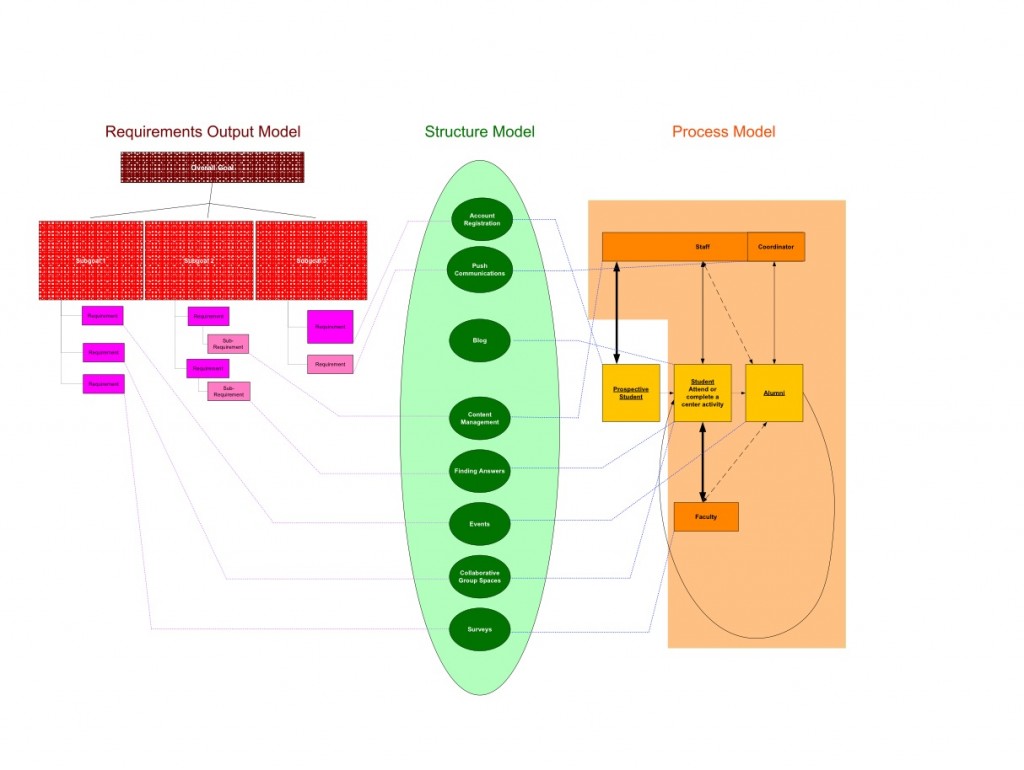
What can you do? Take a look at the Function-Structure-Process Diagram.

Function Structure Process Diagram


The goal of this diagram is to do five things.

  1. Show a clear understanding of the goals (function) of the business or organization.
  2. Show a clear understanding of the process (activities) for the users and how they change over time. Change over time could involve learning something (as in this example), building brand awareness or loyalty, or conquest of new customers.
  3. Show the overall structure of the solution you are proposing which could be a web presence or web application.
  4. Show which specific parts of the structure you are proposing support which functions (goals.)
  5. Show which specific parts of the structure you are proposing support which processes (activities) that the users are engaged in. 

References and Further Reading (esoteric warning)

Yes, this is systems thinking with plurality.

Design and Philosophy by Peter Kroes, Pieter E. Vermaas, Andrew Light and Steven Moore

For Students by Students

Monday, August 3rd, 2009

Cool blank books and sketch books at Barnes & Nobles by Pratt and SCAD students.

Now go buy some!

Cheese Window of Engagement

Friday, July 31st, 2009

Cheese Window of Engagement: Saxelby Cheesemongers in Essex St Market

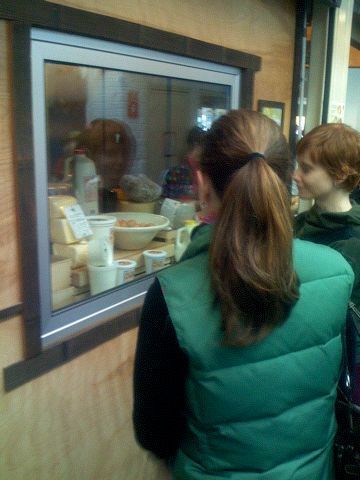
I look to the retail in the physical world in stores and markets for inspiration on how to better engage customers. This photo of two people in front of what I call the “Window of Cheese Engagement” at Saxelby’s in Essex St Market, NYC is a source of inspiration. I talked about what is going on in this photo during my Placemaking and IA talk at the IA Summit in Miami in 2008. It still awes me, and so I wanted to expand on those thoughts.

There is an incredibly rich level of engagement going on here. The two women are looking at cheese the main product that Saxelby’s sells in addition to milk, butter, eggs and yogurt. The product is close to eye level, it is in a setting (not a product alone by itself), it is well lighted, it is even treated as if in a picture frame. The two women at do more than just looking at the products together, they can talk to each other and with the reflection in the glass even maintain some eye contact if not at least situational/peripheral awareness of what the other woman is looking at and what her facial reaction and body language is. WOW! That is so much more being done than we right now struggle with in the online spaces. They do such an great job on supporting product, product placement and context, shopping as a social experience, co-shopping, and cross-selling.  The Window of Cheese Engagement falls into the category of a pilgrimage shopping ecology (though it even pulls in the milk category, which is usually fits into the utilitarian shopping ecology.

References
Shopping Ecologies Powerpoint
Shopping Ecologies Whitepaper
Placemaking Presentation done at Miami IA Summit 2008
Article on Saxelby’s The best Cheese Shop in NYC (New York)
Saxelby Cheesemongers Website

Office Of Elevators And Amusement Rides

Thursday, July 30th, 2009

What is a good/bad label? Is “Office Of Elevators And Amusement Rides” a good label?

Labeling is one of the major elements of user experience. When I was in South Carolina in an elevator in a hotel I looked and saw this sign posted. It threw me for a loop. Perhaps it was going to be a safe ride, but am I going to be turned upside down in the middle? Why were these two departments of Elevators and Amusement Rides together? Perhaps they were located in the same room. And I guess I can kind of see the logic, but it didn’t make me feel safer than if it was ONLY the Office of Elevators. No matter the logic that drove the initial naming convention, context matters, and most people are going to encounter this label while they are RIDING in an elevator.

References
Another blogger on the topic of Elevators and Amusement Rides
SC Office of Elevators & Amusement Rides Website

Tips for Better Bodystorming

Wednesday, July 29th, 2009

9 Tips for Better Bodystorming
Last weekend at Overlap09, the fourth Overlap, we did a Bodystorming exercise. Dave Gray, the organizer of Overlap09 asked me to talk about my work on Bodystorming. Dave Gray characterized Bodystorming perfectly as sketching not with a pencil and paper, but with our bodies. As the Bodystorm teams (of super thinkers/doers) went through the exercise I realized it would have been better to have had a list of tips that you can use for better bodystorming. Here is that list and some observations/learnings as well.

  1. Bodystorm groups over five people are fine, even up to 8 people worked well.
  2. Everyone needs to have a role, even if it is a prop.
  3. Freely use large cards that label who the different people are playing (Barista, CNN news feed, Dr).
  4. Use thought-bubble cards to show what an actor is thinking versus what they are saying. “Good morning to you, How can I help you?” while someone holds a thought-bubble card above their head that shows they are really thinking “A–hole.”
  5. Have a narrator, or color commentator that explains things to the crowd. That keeps the meta-talk to a minimum.
  6. The narrator can pretend it is like watching  TV and use a TV controller, to stop action, rewind, or fast forward.
  7. Your props can have feelings, thoughts, and they can talk.
  8. When your group is working through its presentation, try to approach it with the spirit of improv’s “Yes, and . . . ” rather than “No, but . . . “
  9. Bodystorm teams that did two skits showing a before and after were very effective.

Bodystorming References
Bodystorming Resources

Overlap09 Poster

Tuesday, July 28th, 2009

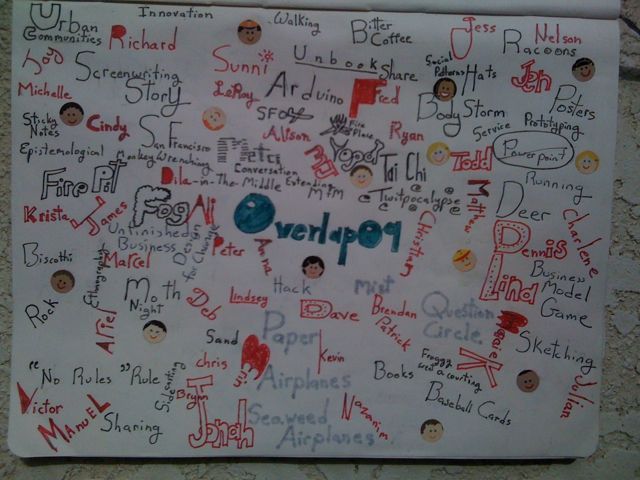
On my long plane ride back from overlap09 I drew this poster of the people, thoughts, activities, and feelings I had. It was just one of two Overlaps I have been able to attend, but it energizes me so much and changes how I think, I just had to make something right away to express it.

Dave Gray was our facilitator. He did an awesome job. Thank you Dave!

The Top Ten Mistakes UX (User Experience) Leaders Make

Friday, July 24th, 2009

Top 10 Mistakes UX leaders make

1. Not having a clear understandable process. UX leaders need to build process so new talent can learn and so outsiders can understand UXs value. And even more than just understand, so outsiders can collaborate and participate with the UX team.
2. Putting process before place. UX leaders need to make sure the right tools, supplies, and places to do UX work are available or else no amount of process will save you.
3. Using Usabilty Testing as design arbitrar whenever there are disagreements. Simple A/B testing is not going to take you to the next level.
4. Not playing nicely with Prodct/Project Management.
5. Managing documentation rather than design. We need to be concerned with behavior and impact.
6. Having more requirements documents than design briefs. Feature lists are no substitute for business strategy.
7. Focusing on implementation rather than evolution.
8. Not building unity of purpose both within and outside of your department.
9. Not timeboxing both divergent activities (idea generating) AND convergent activities (decision making & consensus building)
10. Not having enough whiteboards for both group use and individuals. See mistake #2.

Experience Diagram: Sustainability Day in life

Thursday, July 23rd, 2009

Here is example of an experience diagram. This is a day in a life that focused around sustainability. I did it and it’s about my Monday through Friday daily cycle. I did it at a workshop last year put on by Uday of Sonic Rim.

Things to notice:
The use of pictures and words. Hand rendered and preproduced images. Preproduced images allow for easier comparison between different people’s day in life. A line goes across the page showing begining to end of day.